OSAMD takes off: My win at the German Engagement Award 2022
When I started developing the OSAMD project a little over two years ago, I could never have imagined that the project would go on to have such a "career": first a regional award at JugendForscht and the HAWtech Super Scientist, then a main prize at the BundesUmweltWettbewerb 2021 and now a main prize worth 5,000 euros at the German Engagement Award, the umbrella award for prizes recognizing civic engagement in Germany. With project funding from the Federal Ministry of Education and Research (BMBF) as well as VDI e.V. (Association of German Engineers) as part of the project funding pot "LABS for Chips", the further development of the project could be realized and a pilot workshop series could be launched. In addition, the project received funding from the City of Heidelberg and the Youth Foundation Baden-Württemberg, which made it possible to carry out numerous further workshops with young people and students in the Rhine-Neckar district.
The OSAMD project: A summary
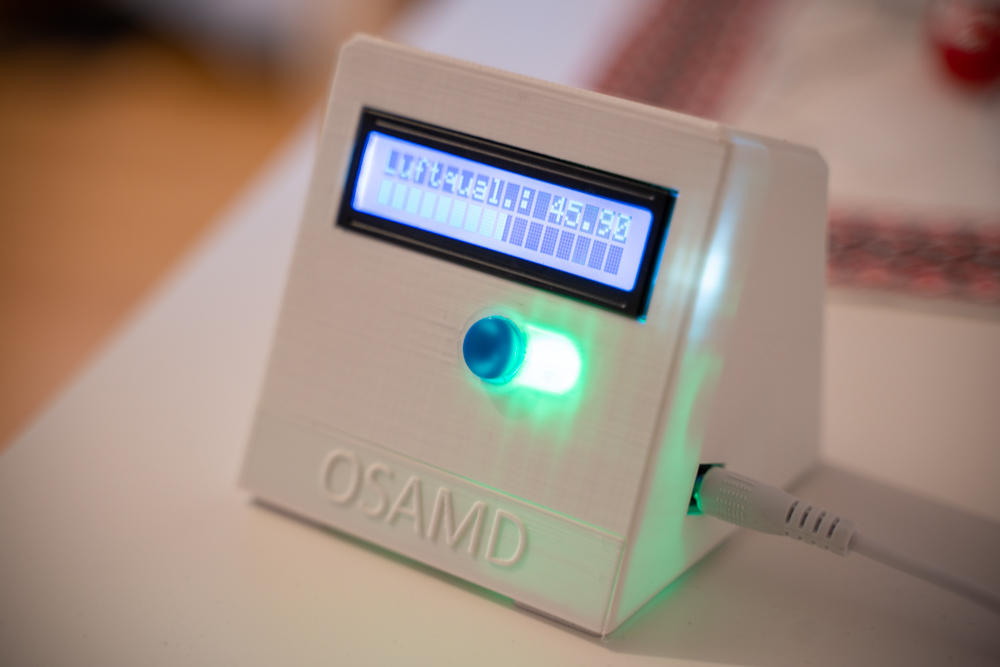
High air quality is important. Really, it always has been, because in better air you can concentrate for longer. Especially at school, though, the topic is more important now than ever, because due to COVID-19, regular ventilation breaks had to be and in some cases still have to be taken in all schools across Germany. What is good in itself becomes harder to implement day by day in winter: the cold winter climate and the heaters in the classroom are locked in a daily battle over the air temperature, with the heating only able to warm the air through considerable heat output, which leads to enormous increases in heating costs and higher CO2 emissions. In addition, it is not always possible to heat enough. At my school, the room temperature is only around 15 °C when outside temperatures are around freezing. One possible solution to the problem is CO2 traffic lights, which continuously determine the air quality in the classroom. This allows a direct response to the aerosol load (which is proportional to the CO2 concentration), making intelligent ventilation possible. But these CO2 traffic lights are expensive to purchase and inflexible to use: devices suitable for classroom use cost around 280 euros and can then only be configured with a proprietary application. That is why in 2020 I developed a sensor system that, thanks to a modified measurement system based on the relationship between ammonia concentration and CO2 levels in indoor air, can be implemented affordably and can also be replicated by students themselves - a great project for introducing younger students to electrical engineering. Better air quality improves concentration, and avoiding unnecessary ventilation intervals also makes considerable energy savings possible.
OSAMD stands for Open-Source Air-Monitoring Device; a full blog post about the project can be found here.
The German Engagement Award
https://youtu.be/f8DNK0yhRkg
Let me briefly quote the press release of the German Engagement Award (linked in full below) about the award itself:
"The German Engagement Award is the most important distinction for civic engagement in our country. It inspires engagement, makes it visible, and strengthens appreciation for it. As an award of awards, it connects the competitions that encourage voluntary engagement. It offers advice and exchange to around 650 engagement competitions from all over Germany. Each year, these engagement competitions can nominate their first-place winners for the German Engagement Award. In 2022, 463 committed individuals and initiatives were nominated. A total of 127,602 votes were cast in the public vote for the Audience Award. Since 2009, the initiator and organizer of the German Engagement Award has been the Alliance for the Common Good, an association of major umbrella organizations and independent organizations as well as experts from the non-profit sector. Funding partners are the Federal Ministry for Family Affairs, Senior Citizens, Women and Youth, the Deutsche Fernsehlotterie, and the Deutsche Bahn Stiftung."
The future of the project
Motivated by the awards I have won and the funding I have received, I plan to expand the project in the near future and add functions that I have been planning for quite some time:
On the one hand, there is temperature and humidity measurement, which has already been implemented in hardware in all measuring stations built since last summer (now a three-digit number) - a larger software update is coming in the next few months. At the same time, this will also include the possibility of calibration, so that the measuring stations can finally provide more precise data.
In addition, a first hardware revision with Wi-Fi connectivity and centralized measurement data collection is already in the works. Beyond that, an option for local measurement data collection is planned, and for this a real-time clock will also be added to the project. In this context, however, I am also making sure that the partial costs remain as low as possible. I also plan to compile the greenhouse gas emissions involved in the "production" of a measuring station.
Contact, downloads, and closing notes
At this point, I would also like to thank everyone involved in the project who has actively supported me in implementing the idea over the past few years: first of all, the local maker scene in the Heidelberg area deserves a mention, having provided me with expertise and a great deal of inspiration (and in some cases special sensors on Sunday evenings at 10:00 p.m.): the RaumZeitLabor Mannheim (RZL), the former Makerspace Heidelberg at the German-American Institute, and more recently also the CoMakingSpace Heidelberg. Also, a huge thank-you to Marc Eckhardt from IPN Kiel (Leibniz Institute for Science and Mathematics Education) for the fantastic project support during the BundesUmweltWettbewerb and for forwarding it to the German Engagement Award.
Here is my contact information in case there are any questions about the project or the German Engagement Award:
Paul Goldschmidt, [email protected] / [email protected].