AI is changing the world – and what does that mean for me? (Companion post to the talk)
When I received the invitation at the beginning of March to give a talk on the topic of artificial intelligence at this year's TINCON (Teenage Internetwork Conference), the decision to accept it came quickly: after taking part in the German National Artificial Intelligence Competition, for which I had engaged intensively with the topic in 2021, this was a great reason to find my way back into the subject.
This post now provides the companion information for the talk—in other words, the things I would have liked to include in the roughly 20 minutes, but couldn't fit in for reasons of time or focus. And so the talk "AI is changing the world - and what does that mean for me?"
Background information on the talk
The talk was given on June 8 at TINCON Berlin in front of a young audience (ages 13 to 25). It was announced under the title “AI is changing the world – and what does that mean for me?” My goal was therefore not to provide a technical introduction to the world of AI; others have already done that well in various formats. What mattered most to me was to shed light on the topic from its different angles and show the connections to the lives of young people (a group I still count myself among). With such a huge topic and a 20-minute talk, it definitely wasn't easy to fit these points in meaningfully. Whether I succeeded is for everyone to decide for themselves. For example, I would have liked to go deeper into the moral aspects, especially with regard to education. But that would have gone beyond all scope, so instead I tried to emphasize the service aspect.
I myself am explicitly not an AI researcher, but rather someone generally interested in the topic and, through my participation in the German National Artificial Intelligence Competition as well as other events of this kind, fairly involved in current developments in the field.
The ChatGPT question
The biggest challenge of the entire talk, however, was balancing how much time I would spend talking about ChatGPT: on the one hand, OpenAI's ChatGPT is currently THE topic when it comes to artificial intelligence and is particularly relevant in the educational context, which was supposed to directly affect the audience of the talk. On the other hand, the topic has already been examined online in hundreds of thousands of hours of video material from every conceivable angle down to the last detail, so the time on stage could just as well have been devoted to other topics. In the end, the best approach for me was to more or less structure the talk around ChatGPT, but then quickly broaden the range of topics and only mention once in the service section that prompts.chat offers a collection of tried-and-tested chat prompts that make working with ChatGPT much more pleasant. The fact that ChatGPT is the topic in the media right now also showed up in the intro video:
The intro video
TINCON gave me the platform to create an intro video. My goal with the video was to make a quick cut through the current media landscape and anchor the topic in the absolute overpresence of ChatGPT. So that’s exactly what I did: I quickly pulled together a few clips on YouTube, set them to the drum beat of “Fallin’ (Adrenaline)” by “Why Don’t We,” and just like that the first almost 60 seconds of the talk were done. By the way, what really helped me while searching for the clips was that in Adobe Premiere Pro they are searchable by content with timestamps thanks to the transcript feature—so it was also easy to find the parts in the 20-minute Japanese segment that were interesting for the compilation.
The Sankey diagram
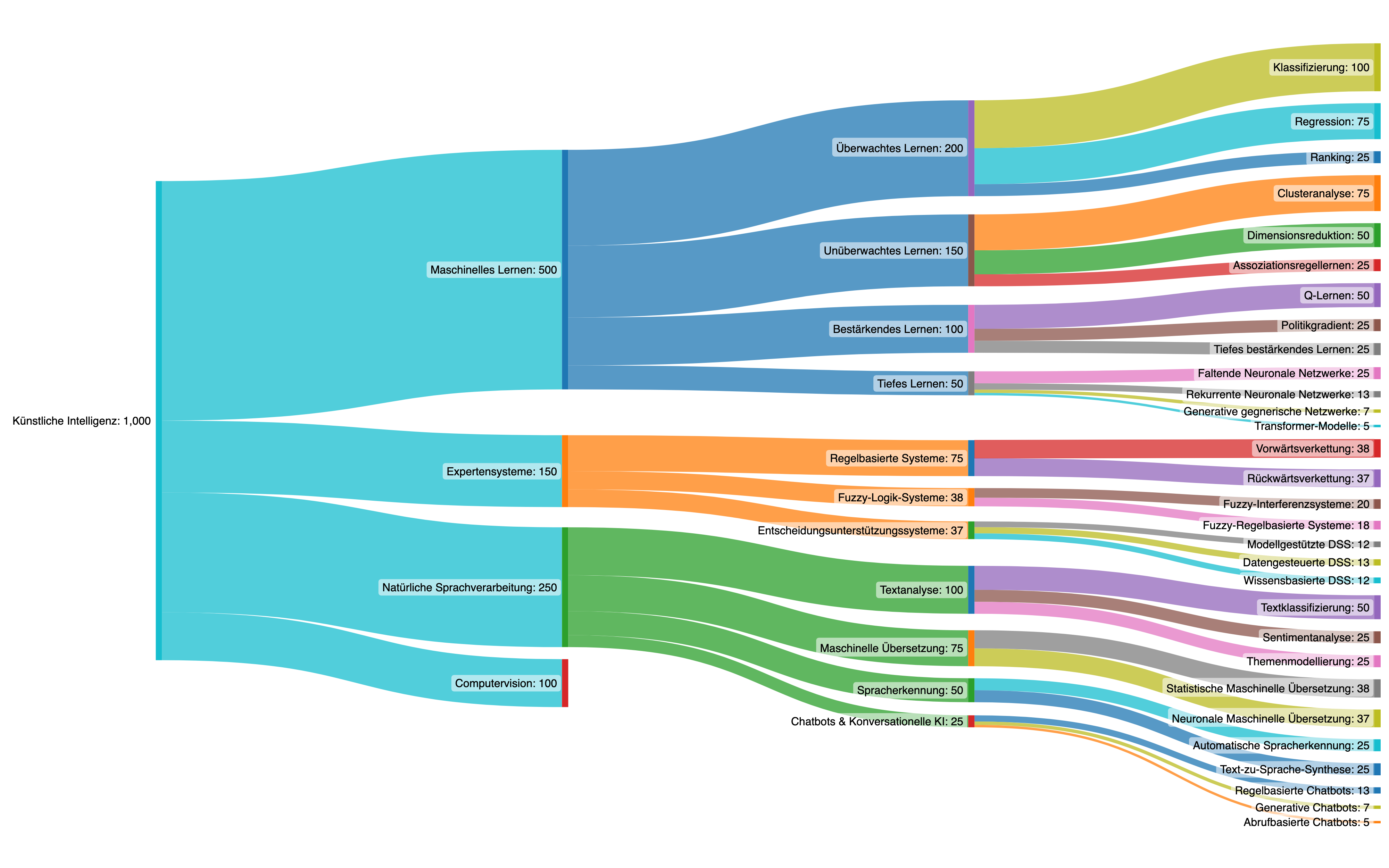
For many more technically inclined people, the brief look at the Sankey diagram I created to give an overview of the topic clusters within artificial intelligence was interesting. My goal with the diagram (which I also published in English because the topic is easier to explain there) was really just to provide an overview—the distribution, meaning how much weight each topic gets, is practically chosen artificially and not based on hard data, because the relevant data sources simply do not exist. I had started writing a script that would use publish-or-perish to go through the abstracts of all published studies in order to derive a weighting in the diagram based on research relevance, but for a 30-second slide this unfortunately wasn't possible for time reasons.
What didn’t make it into the talk
As already described, one of the hardest parts was giving this huge topic any kind of clear structure at all. That’s why more and more points gradually fell away until the topic had finally been boiled down to 30 minutes (and even then the presentation still had 62 slides, so just under 30 seconds per slide, although some were played automatically via triggers and in quick succession). Here’s a look at everything I still would have liked to cover in the talk:
The technical side behind AI
No question: if you want to use a technology, you should ideally also understand how it works. I personally would have been interested in the technical part (especially taking a look at the transformer methodology), simply because that’s the area I still come from most with the Chirpanalytica project. But there are already excellent talks on the subject, and the service aspect isn’t particularly high if you spend 30 minutes looking at hidden layers and loss functions.
Don’t trust everything you see: generative AI and fake photos
A Pope in a hip white puffer jacket, Harry Potter characters in Pixar style, Obama and Merkel playing in the sand: all of these images were created with programs like DALL-E, Midjourney, or Stable Diffusion and, after ChatGPT, are probably the AI topics receiving the next highest amount of media attention. That’s why it would also have been very exciting to look at a few examples (some of them really very good) and take a look at the question of whether AI is actually being creative here. At least I can include the examples I find particularly exciting here:



Previous image Next image
AI ethics and legislation (LexAI)
Under what conditions is it justifiable to replace jobs with AI? If I discreetly get help from ChatGPT during my German exam, is that just cheating, or am I actually preparing myself for the future? What exactly is transparent AI, and who is liable if something really goes wrong in an AI application?
This point opens up hundreds of exciting questions, especially against the backdrop of the AI regulation being prepared by the EU. But unfortunately this opens up such a huge can of worms that even a four-hour talk would seem short. If you want to read more about it, you can find good resources on the EU website on the topic.
AI in education
In an earlier version of the talk, I had even planned at one point to speak almost exclusively about AI in education. Especially for young people, this is an exciting topic, and there are many developments here that would have been worth a closer look—one important point from these developments that I especially want to highlight is still close to my heart: educational equity.
In my opinion, schools need to provide students with access to good language models like GPT4 through their own platform: right now, people with more money can simply afford ChatGPT Plus for 20 euros a month and achieve better results than students without that financial means. That cannot continue!
The problems on the path to further AI development
I touched on it briefly, but to return once more to the question of "what options do we even have left to improve large (language) models like ChatGPT?" The fact is, we are already feeding these models practically the entire internet—so where are we supposed to get even more information from?
Read more
Below are just a few links on the whole topic that I find interesting:
prompts.chat: good ChatGPT prompts broken down
One more thing for a laugh: ChatGPT fail collection