"As soon as it works, the plan gets changed": Homeschooling in Baden-Württemberg seven weeks later
Seven weeks after school started at home, homeschooling is finally working well. If only there weren’t an election campaign to be fought in politics.
Disclaimer: all opinions in this post reflect my personal point of view.
Every beginning is hard
When school started up again at the beginning of January 2021 (as described in this post), the technical problems were so fundamental that classes often could not take place at all: the state of Baden-Württemberg’s learning platform was so overloaded that it was often impossible even to open the landing page.
January 7, 2021, 4 days before school started: 2 pallets of servers with 7 additional servers for Moodle are delivered. https://t.co/nQWovuvVapJanuary 11, 2021
But: servers were delivered, and once they gradually went online, most of the server problems were resolved.
At least Moodle ran fairly stably after that; recently there has only been an outage about once a week.
With BigBlueButton, the video conferencing software, things looked different, though. At first there were no video conferences without outages at all; by now the load has decreased and the servers have also been expanded, but to this day no really smooth video conferences are possible, and several times a week entire conferences are seemingly terminated for no reason.
Actually, everything is going pretty well now!
And so the weeks passed by; every week—depending on the teacher—new assignments were handed out, video conferences were held, and little videos were sent around explaining new material. More and more functions of the learning platform were gradually discovered, so some teaching methods that are difficult to implement even in in-person classes were tried out: group work in particular was one of Moodle’s strengths, as were the many types of assignments that could be made available to the students (SuS). As already noted above, not everything ran 100% perfectly, but the material could still be covered in a good learning atmosphere.
When election campaigning destroys school lessons
On March 14, Baden-Württemberg will elect a new state parliament. Among those running for the office of Minister-President are Winfried Kretschmann (Greens), the current Minister-President of Baden-Württemberg, and Susanne Eisenmann, the current Minister of Education, Youth and Sports.
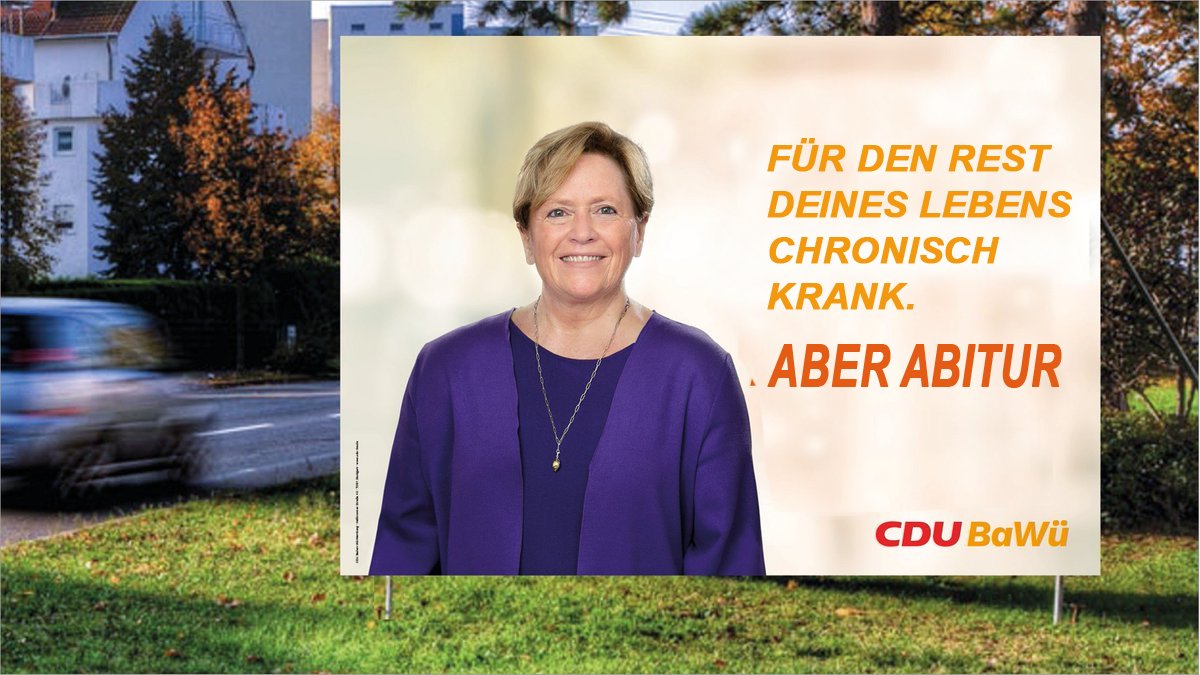
The latter has been struggling with poor poll numbers for weeks. In search of good news, Ms. Eisenmann therefore decided—at least that’s how I explain it to myself—to reopen the schools from 22 February onward. Despite stagnating infection numbers, schools were reopened last Monday, albeit only partially: the graduating classes (at Gymnasium with G8, that means grades 12 and 13) at half class size.
The other half, at least that is the plan, will continue to be taught from home. And that is also the main problem with the plan: besides the (in my view) fatal idea of reopening schools now in the face of coronavirus mutations and barely falling infection numbers, the illusion of functioning hybrid teaching is a reckless misjudgment. Just when online teaching had started to work quite well for the first time, teachers are now expected to teach two groups at the same time: 50% of the class in person (around 8–15 students) and 50% of the class at home in a video conference.
In practice, this means that depending on the school’s technical equipment, online teaching is hardly feasible. Over the past week I spoke with various teachers and students about the current situation; at some schools the internet connection is already completely maxed out with just three parallel video streams. But even at schools with better equipment, smooth lessons are not guaranteed: video conferencing tools like BigBlueButton are not designed to support this kind of hybrid teaching, which is why some compromises have to be made in class. For the class to hear the people in homeschooling, an image signal has to go from the PC to the projector, because it splits the data stream into image and video signal. That means, for example, that it is no longer possible to use the document camera in class. Instead, some teachers are now taking the webcam, which was actually intended for filming the board and the teacher, and attaching it to a tripod so that documents on a table can also be filmed. But this solution also has plenty of disadvantages: the microphone then points at the document as well, so the audio quality drops. That is especially tragic because even with the microphone in the "correct" position, voices from the classroom are barely audible. So teachers now repeat everything that is said by students.
Thanks to the requirement to wear medical masks during lessons, school periods have been shortened: instead of 90 minutes per lesson block, there are now only 75 minutes of teaching.
Taken together, I estimate that with this kind of hybrid teaching the material can now be covered at least 30–40% more slowly, and yet the curricula remain just as full. I kept count once: within the first week of classes, teachers said 14 times that pure homeschooling had been much better. In general, I observe a great deal of incomprehension about the decisions of the Ministry of Education (first and foremost about reopening secondary schools; the fact that primary schools are open again is less controversial).
The quiet helpers of the homeschooling period
Since for me homeschooling has largely come to an end with the decision of the Ministry of Education, I would like to take this opportunity to thank the people who made the homeschooling period possible in the first place.
First and foremost, there is the Hopp Foundation together with the Medienzentrum Heidelberg, who provided a free Jitsi instance (comparable to BBB); this tool made classes possible, especially in the first weeks of pure homeschooling when the state education servers were failing.
Then there is also the IT team of the state university network, who surely put in many overtime hours to deploy the servers in a short time so that Moodle could be reached again as quickly as possible.
Thank you for all the work.
After a few technical problems this morning - which we were fortunately able to fix - our Jitsi instance was used by 10,000 users over the course of the day, with up to 3,000 at the same time. @HoppFoundation @medienz_hd Thanks @twittestbox, @StefSteel and the tech team! pic.twitter.com/pby5tJyUadJanuary 11, 2021