Cycling through Scandinavia: The Preparation [Prologue]
A cycling trip through Scandinavia is one of the most valuable experiences you can have - but what do you actually need to plan, and what preparation does a bike trip through Scandinavia require?
When I was working on my summer plans in June of this year, I was faced with the following situation:
Six weeks of summer vacation. Actually a perfect opportunity to immerse yourself in foreign cultures and truly experience more than just a purely touristy holiday (that’s how I explored the west coast of the USA back in 2019). However, COVID still played a major role in travel planning, and longer stays in other countries were either impossible or very difficult to plan. There were also hardly any internships taking place in person again, and spending several weeks of my summer vacation in front of a screen doing a remote internship was not an option for me. So I looked into what kind of adventure I could take on without long-distance travel and largely independent of infection rates. What came out of it was a rough plan for a multi-day cycling tour to Scandinavia. The advantages of such a tour were that I could explore two wonderful Scandinavian countries without taking a flight or international train journeys: Sweden and Denmark. Both countries are also known for very good bike paths, few hills, and a bike-friendly culture.
With this idea, the months passed until the beginning of my last summer vacation from school was just around the corner. And with about a week left until the planned departure, I began to look up the destinations in detail.
This detailed post documents my summer adventure in three countries by bike along rocky coastlines, over sand dunes, and through forests in nine parts - so grab a cup of tea and enjoy the journey.
Chapter "0": The Preparation
An undertaking like a multi-day cycling tour requires preparation. Train and ferry journeys in particular often need to be booked some time in advance, especially if you want to take your bike with you. So with my seven days of preparation time, I was really cutting it close - three to four weeks would actually have been much more relaxed.
But first I needed an exact route: where did I want to ride from and to each day, were there difficult stretches or major climbs in between? I could leave out the latter for Scandinavia, since the Scandes are not reachable in eight days (there and back). The destination of my trip was the first thing I settled on: in Forst (Lausitz), I could meet acquaintances who could take me (and my bike) back home to Heidelberg after a few days of relaxation. In search of a starting point, I went exploring on Google Maps for ferry connections (thankfully, they are marked there) from Germany to Sweden. The requirements for the connection were to have as little distance as possible in Sweden and to be able to reach the departure port easily by bike or train.
I found the Sassnitz -> Ystad route operated by FRS Baltic, which makes the crossing to Sweden in less than three hours, to be a very suitable option.
Next came the search for a connection from Sweden to Denmark - from Ystad I would ride west toward Copenhagen, so I would need another ferry connection, or better yet a bridge to Denmark. The Öresund Bridge would have been the natural candidate, but unfortunately the bridge cannot be used by bicycle. A train ride from Malmö to Copenhagen would have been possible, but because I was booking the journeys so late, taking a bike was no longer an option.
A bit farther north, however, there was a connection from Helsingborg to Helsingør, which can be crossed quickly and affordably by ferry. That’s why I chose Helsingborg as my overnight stop, so that early the next morning I could ride from Helsingør to Copenhagen in Denmark (around 65 km).
So the following plan was set:
Sleep in Sassnitz on day 1, then travel via Ystad to Malmö and stay there as well, then continue on to Helsingborg. Spend another night in Helsingborg, take the ferry across the Öresund Strait in the morning, and continue straight on to Copenhagen. That would then leave me four days to get from Copenhagen to Lusatia.
Planning then continued with the ferry connection back to Germany, and only two options came into consideration here: either from Rødbyhavn to Fehmarn and then from Kiel toward Berlin, or from Gedser to Rostock. Since the connection to Rostock was faster and easier to reach from Copenhagen, I chose scandlines for the final sea crossing from Gedser to Rostock. While it would have taken me three days to get from Copenhagen to Rødbyhavn, Copenhagen to Rostock was realistically manageable in two days.
With that, the rough framework was in place, and the first thing I booked was the connection from Ystad to Malmö: 34 euros later (5 euros of that for the bike ticket), the first boarding pass landed in my inbox. I couldn’t pre-book the other connections across the Öresund Strait and to Rostock, so next I turned to finding accommodation.
It quickly became clear that I would definitely have to camp - hardly any youth hostels still had space, and even in Stralsund the youth hostel no longer had any beds available: because even if the booking tool of the German Youth Hostel Association says "Rooms available from xy€" after entering the location and date, you can only actually see availability after clicking on "Reserve room." But since before that I had only clicked through to the first "Rooms available from xy€" screen, this option unexpectedly disappeared as well.
On the other hand, quite against all expectations, I immediately found a spot at the Copenhagen Youth Hostel, which I included in my plans right away. Apart from the overnight stay in Rostock, where I found a cheap hostel on the edge of the city, I either found no accommodation at all or only very expensive hotels, which were not an option for me. I definitely had to bring the tent - so I decided to camp on all the other nights (in Berlin I was luckily able to stay with a friend; otherwise that stop would have caused me even more headaches).
Lastly, I took care of the train connection from Heidelberg up to the area near Sassnitz. As it turned out, booking this late created one of the biggest problems of the trip: defying all logic, when bicycle transport is selected in the DB Navigator, it does not only show connections with free bike spaces, but all connections with trains that potentially offer bike spaces. Even if you click all the way through to payment, the check of whether there are actually any spaces left for bicycles is only carried out when the ticket is actually booked, in parallel with the money being debited from your account. That makes it almost impossible (especially as a BahnCard 100 holder or when using the DB summer ticket) to find out when taking a bike is still possible at all. After 2 hours (!) at the DB travel center, I was finally able to find a bizarre connection via Mannheim and Berlin where taking the bike was still possible.
Happy to have found anything at all, I booked the connection, and with that the framework of the trip was in place three days before departure.
Preparing the bike for the trip
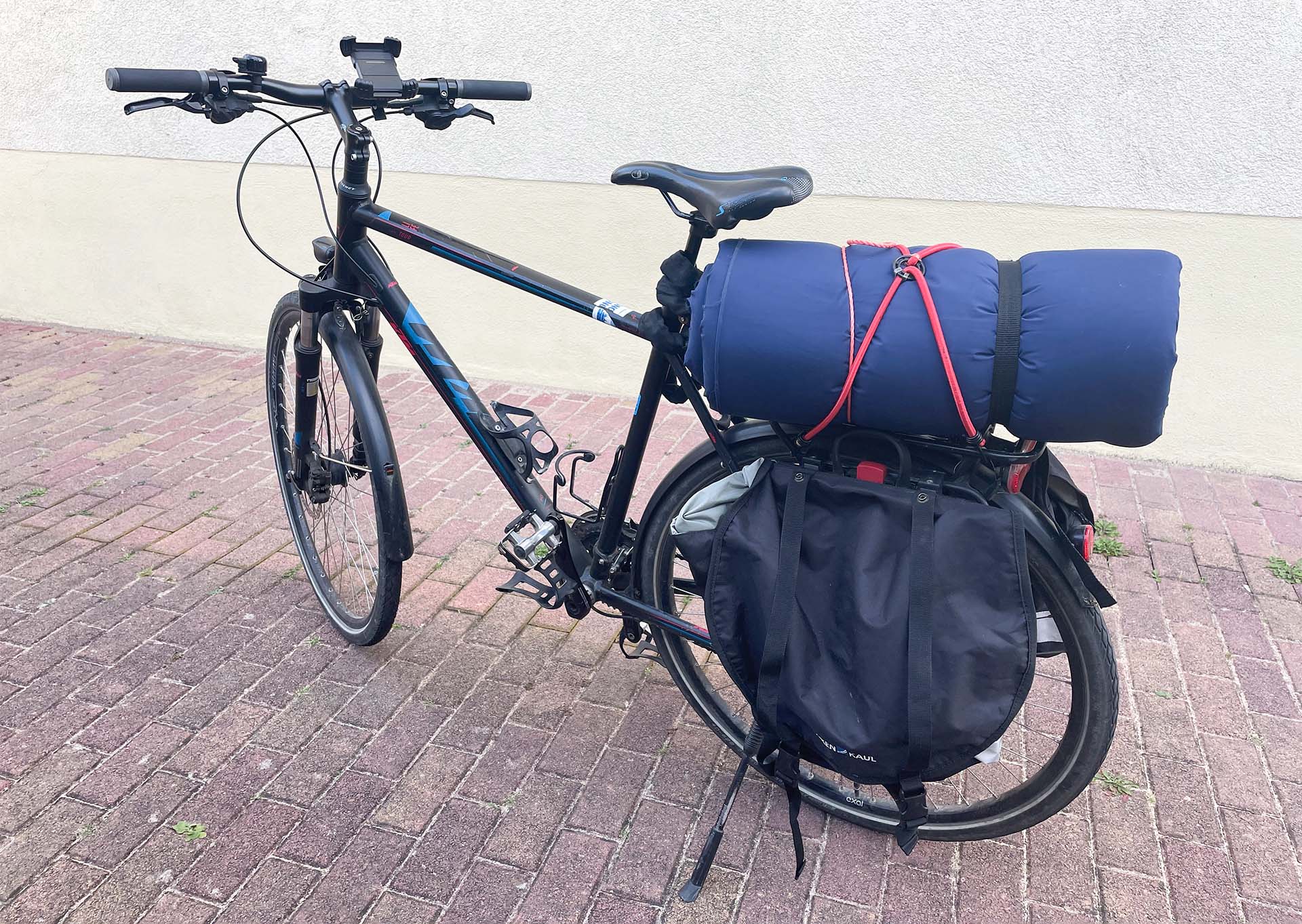
Before departure, I first had to get my bike ready - besides checking it over, pumping up the tires, and oiling the chain, I also removed the basket and instead mounted the brackets for two rear panniers. Two bottle holders in the frame completed the setup of my KTM Life Tour.
Along with clothes, some camera gear, and plenty of water, I packed a bike pump and repair kit as well as a spare inner tube. I also brought swimwear for the Baltic Sea and provisions in the form of granola bars.
All of that fit comfortably into two panniers, though I still took a small backpack for valuables and the little bit of tech I had with me.
Part 2: The start of the cycling tour will be published next week, here I’ll then add a link to that part as well.